How Portable Power Stations With Solar Panel Pairing Are Changing the Way Remote Workers Handle Off-Grid Travel
Chris Martinez
07/24/2026
5 min read
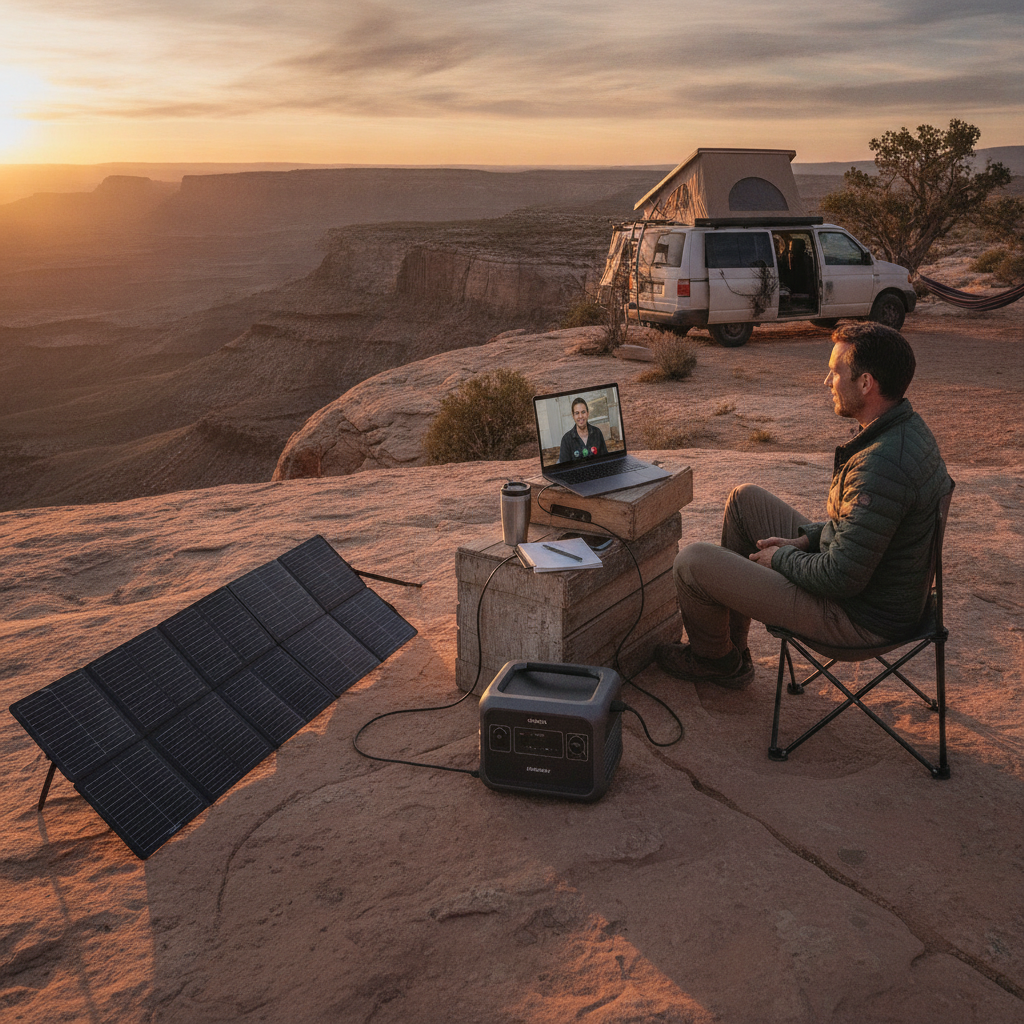
Somewhere between a mountain ridge in Colorado and a coastline in Portugal, a quiet transformation has been unfolding. Remote workers who once chased reliable Wi-Fi in city cafés have begun moving in a different direction — outward, toward landscapes that offer silence and space rather than espresso and ethernet. What made this shift possible wasn't a change in attitude so much as a change in equipment. The portable power station, paired with a foldable solar panel, has become one of the defining tools of a new kind of mobile work culture, one that measures productivity not by proximity to an outlet but by the quality of the view outside the window.
The Quiet Infrastructure of Off-Grid Work
For years, the phrase "working remotely" carried an implicit asterisk: remote, yes, but only as far as the nearest power source would allow. Laptops, phones, cameras, satellite hotspots, and portable monitors all demand electricity, and that dependency quietly tethered the most adventurous remote workers to campgrounds with hookups or hotels with functioning outlets. Portable power stations changed the geometry of that constraint. Devices like the EcoFlow DELTA Pro and the Jackery Explorer line gave workers access to hundreds of watt-hours of stored energy — enough to run a full workday and well into the evening — without a single cord connecting them to the grid.
Solar Pairing as the Missing Variable
A power station alone, while genuinely useful, is still a finite resource. Fill it once, use it, and the clock starts counting down. Solar panel pairing is what transforms a power station from a battery into a self-sustaining system. Foldable monocrystalline panels — the kind that fold flat for transport and unfold to face the sun like a small, silent rooftop — can slowly but steadily replenish a station throughout the day. Goal Zero and Bluetti have built strong reputations in this pairing category, offering panels that connect seamlessly to their respective stations and regenerate capacity during hours when the user is focused on a video call or a deadline. The cycle becomes intuitive: work while the sun works.
Wattage, Weight, and the Honest Math of Capacity
Choosing the right station and panel setup involves a kind of practical arithmetic that rewards honest self-assessment. A remote worker running only a laptop and a phone needs far less capacity than someone operating a mobile video editing suite or a drone charging station. Mid-range stations in the 500 to 1000 watt-hour range cover most knowledge-worker needs through a standard eight-hour day, while heavier creative setups may push toward the 2000 watt-hour tier. Weight matters enormously in this calculation — a station that looks ideal in a product listing can become a liability on a hiking trail or in a compact camper van. The most experienced off-grid workers treat capacity and portability as a ratio to be optimized, not a spec list to be maximized.
The Workspaces This Technology Is Making Possible
The cultural term vanlife — referring to the movement of people who live and work from converted vans or camper vehicles — was already gaining momentum before portable power matured into what it is now. What solar-paired stations have done is raise the ceiling on where and how long those van-dwellers and tent-workers can stay productive. A canyon in Utah that previously offered only a weekend's worth of stored power can now sustain a work week. The Dolomites, the Scottish Highlands, the high desert plateaus of New Mexico — places that were once purely vacation destinations are becoming genuine, if temporary, offices. The station sits in the corner of a converted van or beneath a tarp awning, quietly absorbing energy while its owner works through a deadline with a ridgeline as the backdrop.
Managing Workflow Around the Weather
Off-grid work introduces a variable that office-based employees never encounter: the forecast as a logistics factor. On overcast days, solar input drops significantly, which means power management becomes a conscious skill. Experienced off-grid workers develop what might be called energy literacy — an awareness of which devices draw the most wattage, which tasks can be deferred to conserve power, and when to lean on stored reserves versus when to let the station rest and recharge. Apps like the EcoFlow app offer real-time monitoring of input and output, which turns a previously invisible system into something transparent and manageable. That feedback loop — knowing exactly how much sun has been captured and how much runway remains — changes the way a workday gets structured.
The Broader Shift in Remote Work Culture
What's happening in the off-grid space reflects something larger about how work identity is evolving. The digital nomad — another cultural phrase that has moved from niche subculture to mainstream aspiration — was once defined primarily by location independence. The new version of that identity is defined increasingly by infrastructure independence. The ability to work not just from anywhere with Wi-Fi but from anywhere with sunlight represents a meaningful expansion of what freedom looks like for knowledge workers. Cities like Medellín and Chiang Mai, long popular among nomads for their affordable co-working scenes, are now complemented by landscapes that offer nothing but sky, altitude, and bandwidth — if you bring your own power.
Choosing a Setup That Matches Your Actual Life
If you're considering this kind of setup, the honest starting point is a week's worth of personal power data, not a manufacturer's marketing copy. Track what you actually run, how long you run it, and what your typical workday demands in watt-hours. From there, the right station and panel combination becomes much clearer. Jackery's Explorer 1000 Pro paired with its SolarSaga 100 panels works well for moderate users who prioritize weight savings. EcoFlow's DELTA series suits those who need faster recharge cycles or run more power-hungry gear. Bluetti appeals to workers who want scalable, modular expansion as their setup grows. The goal isn't the most capable system — it's the system that disappears into your routine and lets the landscape be the point.
The scene that opened this conversation — a worker perched somewhere between a mountain and a deadline — no longer belongs to a fantasy. It belongs to a growing category of people who decided that the right technology could make the impractical simply practical. The portable power station and its solar companion didn't invent the desire to work from wild places; they just quietly removed the last argument against it.
More Trending Articles
How Supermarket Deli Counter Pricing Compares to Pre-Packaged Equivalents and Which Categories Consistently Offer Better Value When You Buy by Weight
Jennifer Walsh
10/27/2026